

The digital landscape is a vast, ever-evolving frontier, and for many entrepreneurs and content creators, the Amazon affiliate market represents a goldmine of opportunity. Imagine turning your passion for products, reviews, or helpful guides into a significant income stream, all powered by the world’s largest e-commerce platform. In 2025, the Amazon affiliate market continues to be one of the most accessible and lucrative avenues for online income, offering a powerful way to monetize your digital presence. Whether you’re a seasoned blogger, a budding YouTuber, or someone just starting their journey in online business, understanding the intricacies of the Amazon Associates program and the broader affiliate ecosystem is paramount to your success.
Table of Contents
Key Takeaways
- Foundation First: Understand the Amazon Associates program’s terms, commission structures, and policies as your starting point for any engagement with the Amazon affiliate market.
- Niche is King: Specializing in a specific product category or audience allows for deeper authority, easier content creation, and better conversion rates within the Amazon affiliate market.
- Content is Currency: High-quality, valuable, and engaging content (reviews, guides, comparisons) is crucial for attracting and converting traffic into affiliate sales in the Amazon affiliate market.
- Traffic Diversification: Relying on a single traffic source is risky; aim to generate traffic from multiple channels like SEO, social media, email marketing, and paid ads to sustain your efforts in the Amazon affiliate market.
- Adapt and Optimize: The affiliate landscape, including the Amazon affiliate market, is dynamic. Regularly analyze your performance, test new strategies, and adapt to algorithm changes or market trends to maintain profitability.
Unpacking the Amazon Affiliate Market: Your 2025 Blueprint
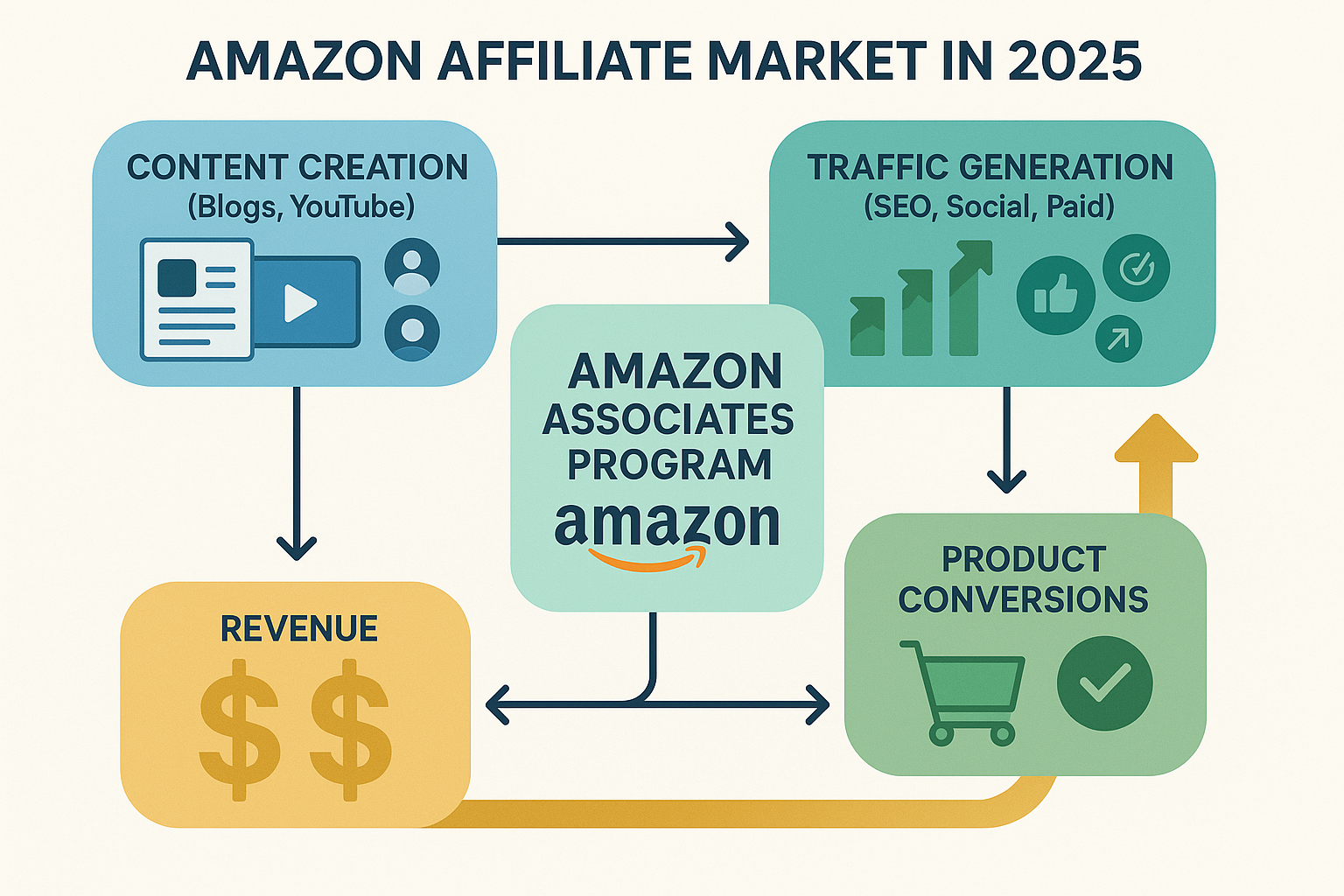
The Amazon affiliate market, primarily facilitated through the Amazon Associates program, allows individuals and businesses to earn commissions by advertising Amazon products to their audience. When a user clicks on a unique affiliate link and makes a qualifying purchase on Amazon within a specific timeframe (usually 24 hours), the affiliate earns a percentage of that sale. Simple in concept, yet powerful in execution. In 2025, this model remains robust, offering a low barrier to entry for anyone looking to step into the world of e-commerce without the hassles of inventory, shipping, or customer service.
My own journey into the Amazon affiliate market began rather serendipitously. Years ago, I started a blog about sustainable living, sharing tips and product recommendations. Initially, it was just a hobby. But as my audience grew, I realized I was frequently linking to products on Amazon. A friend, already an established affiliate, nudged me to sign up for Amazon Associates. “Why leave money on the table if you’re already doing the work?” she asked. That simple suggestion transformed my hobby into a revenue stream, proving that even organic, passion-driven content can be monetized effectively within the Amazon affiliate market.
What is the Amazon Associates Program?
At its core, the Amazon Associates program is Amazon’s affiliate marketing program. It’s the engine that drives the Amazon affiliate market. It’s free to join, and once approved, you gain access to a vast catalog of products and tools to create your unique affiliate links.
How it works:
- Sign Up: Register for the Amazon Associates program. The application process is straightforward, requiring details about your website(s), apps, or social media pages where you intend to promote products.
- Generate Links: Use the SiteStripe tool or the Associates Central dashboard to create special links to any product on Amazon. These links contain your unique Associate ID.
- Promote Products: Share these links with your audience through content like blog posts, product reviews, social media updates, email newsletters, and videos.
- Earn Commissions: When visitors click your links and purchase qualifying products on Amazon within 24 hours (or add them to their cart and purchase within 89 days), you earn a commission.
Commission Structures in 2025
Understanding the commission rates is crucial for strategizing your efforts in the Amazon affiliate market. While exact percentages can fluctuate, Amazon generally pays a flat fee or a percentage of the sale, which varies by product category. It’s important to keep an eye on the official Amazon Associates page for the most up-to-date rates, as they can be revised periodically.
Let’s look at some illustrative examples of what categories might offer in terms of commission rates (these are examples and should always be verified on the official site):
| Product Category | Example Commission Rate | Key Strategy |
|---|---|---|
| Luxury Beauty, Amazon Explore | 10% | Focus on high-ticket items, detailed reviews |
| Digital Music, Video Games | 5% | Leverage new releases, trending content |
| Home, Home Improvement | 3% | Create buying guides, DIY projects |
| Electronics, PC | 2.5% | In-depth comparisons, tech reviews |
| Groceries, Health & Personal Care | 1% | Promote subscription services, essential items |
Note: These are illustrative rates for 2025 and actual rates may vary. Always check the official Amazon Associates website for current figures.
The key takeaway here is that while some categories offer lower percentages, they often have higher sales volume or lower-priced items that convert more easily. Conversely, higher percentage categories might involve more considered purchases but can lead to substantial payouts per conversion. Diversifying the types of products you promote across various categories can help stabilize and grow your income within the Amazon affiliate market.
The Power of the “Cookie” Window
One unique aspect of the Amazon affiliate market is the 24-hour cookie window (or 89-day cart rule). When a user clicks your affiliate link, a “cookie” is dropped on their browser. If they make any qualifying purchase on Amazon within the next 24 hours, you get credit for it, even if it’s not the product you originally linked to! This is a massive advantage, as a customer clicking your link for a book might end up buying a new television, and you’d still get a commission on the TV. If they add an item to their cart and purchase it within 89 days, you also get credit. This broadens the potential for earnings significantly.
“It’s like an unexpected bonus,” I often tell new affiliates. “You’re getting credit for shopping carts you didn’t even know existed!” This aspect makes the Amazon affiliate market particularly attractive compared to some other programs with stricter attribution rules.
Why Focus on the Amazon Affiliate Market in 2025?
In a world teeming with affiliate programs, why is the Amazon affiliate market still a powerhouse?
- Trust and Brand Recognition: Amazon is a household name. Customers trust the platform, its shipping, and its customer service. This significantly lowers the barrier to purchase once they land on Amazon.
- Vast Product Selection: With millions of products across virtually every category imaginable, you can find something relevant for almost any niche audience.
- High Conversion Rates: Because people already shop on Amazon, the conversion rates tend to be higher compared to promoting lesser-known brands or independent e-commerce sites.
- Convenient Shopping Experience: Amazon’s one-click purchasing, Prime shipping, and seamless user experience make it easy for customers to buy, benefiting affiliates.
- Global Reach: Amazon operates in numerous countries, allowing you to tap into international audiences if your content supports it.
The Amazon affiliate market is not just about making quick bucks; it’s about building a sustainable online business around products people already want and need.
Strategies for Success in the Amazon Affiliate Market: 2025 Edition
To truly thrive in the Amazon affiliate market in 2025, you need more than just a website and some links. You need a strategic approach, a commitment to quality, and a willingness to adapt. This involves everything from choosing the right niche to optimizing your content and diversifying your traffic sources.
1. Niche Selection: The Foundation of Your Success
“Riches are in the niches,” as the old saying goes, and it’s particularly true for the Amazon affiliate market. Trying to cover everything will spread your efforts too thin. Instead, focus on a specific, well-defined niche.
Considerations for Niche Selection:
- Passion and Knowledge: Choose a topic you genuinely care about or have expertise in. This makes content creation enjoyable and authentic. My sustainable living blog thrived because I truly believed in the products I recommended.
- Audience Demographics: Who are you trying to reach? What are their problems, interests, and purchasing habits?
- Product Availability and Price Points: Does Amazon have a good selection of products within your niche? Are there products with varying price points (low, medium, high) to cater to different budgets? Higher-priced items, even with lower commission rates, can often lead to better payouts per sale.
- Competition: Analyze existing competition. Can you offer a unique angle, better content, or target a slightly different sub-niche?
- Evergreen Potential: Are the products and topics in your niche likely to remain relevant over time, or are they fleeting trends?
Examples of Lucrative Niches (in 2025):
- Smart Home Gadgets: With technology continually evolving, smart home products (security cameras, voice assistants, automated lighting) are evergreen.
- Eco-Friendly & Sustainable Products: A growing segment of conscious consumers actively seeks sustainable alternatives in clothing, home goods, and personal care.
- Health & Wellness Tech: Wearables, smart scales, fitness trackers, and specialized exercise equipment continue to be popular.
- Niche Hobbies: Think specialized photography equipment, artisanal crafting supplies, specific gaming accessories, or high-end cooking tools.
2. High-Quality, Value-Driven Content
This is where the magic happens. Your content is the bridge between your audience and Amazon. In 2025, generic content won’t cut it. You need to provide genuine value, solve problems, and build trust.
Types of Content that Convert in the Amazon Affiliate Market:
- In-Depth Product Reviews: Go beyond listing features. Share personal experiences, pros and cons, use cases, and compare it to alternatives. Include high-quality images and videos.
- Buying Guides: “The Ultimate Guide to Choosing a _” or “Best _ for Beginners.” Help users navigate complex product categories.
- Comparison Posts: “X vs. Y: Which Gadget is Right for You?” or “Top 5 Alternatives to Product Z.”
- How-To Guides/Tutorials: Show users how to use a product effectively, naturally leading to recommendations.
- Problem/Solution Content: “Struggling with __? Here are 3 Products that Can Help.”
- “Best Of” Lists: Curated lists like “10 Best Wireless Headphones for Running” or “Must-Have Kitchen Gadgets for 2025.”
Content Best Practices for the Amazon Affiliate Market:
- Authenticity: Only recommend products you genuinely believe in or have personally tested. Your audience will sense insincerity.
- SEO Optimization: Research keywords your audience uses. Optimize your content for search engines to attract organic traffic. Use tools like Ahrefs, SEMrush, or Google Keyword Planner.
- Clear Calls to Action (CTAs): Make it easy for users to find your affiliate links. Use buttons, bolded text, and clear phrases like “Check Price on Amazon” or “Buy Now.”
- Mobile-Friendliness: A significant portion of online traffic comes from mobile devices. Ensure your website and content are responsive and load quickly.
- Regular Updates: Keep your content fresh. Product models change, new alternatives emerge. Periodically review and update your posts.
3. Traffic Generation: Getting Eyes on Your Links
Even the best content won’t generate sales if no one sees it. Diverse traffic sources are key for sustainable growth in the Amazon affiliate market.
- Search Engine Optimization (SEO): This is often the most valuable long-term strategy. Optimizing your website for Google and other search engines means free, passive, and highly targeted traffic. Focus on:
- Keyword Research: Identify long-tail keywords with buying intent (e.g., “best noise-canceling headphones for travel 2025”).
- On-Page SEO: Optimize titles, meta descriptions, headings, image alt text, and content quality.
- Technical SEO: Ensure fast loading speeds, mobile responsiveness, and a crawlable site structure.
- Backlinks: Build authority by acquiring high-quality backlinks from reputable sites.
- Social Media Marketing: Leverage platforms like Pinterest (for visual products, guides), YouTube (video reviews, unboxings, tutorials), Instagram (lifestyle products, Reels), and Facebook (community building, group discussions).
- Anecdote: I once saw a small Instagram creator gain immense traction by simply showcasing practical uses of budget-friendly kitchen gadgets they found on Amazon. Their authentic, unpolished videos resonated far more than glossy ads.
- Email Marketing: Build an email list by offering valuable lead magnets (e.g., a free buying guide, a checklist). This allows you to communicate directly with your audience, share new content, and promote relevant Amazon products.
- Paid Advertising: For quicker results and scaling, consider Google Ads or social media ads (Facebook/Instagram Ads). Target specific demographics with highly relevant products. This requires a budget and careful A/B testing to ensure a positive ROI.
- Forum and Community Engagement: Participate in relevant online forums, Reddit communities, or Facebook groups. Offer genuine help and recommendations (where allowed) and occasionally drop your affiliate links subtly. Avoid spamming.
4. Legal & Ethical Considerations: Staying Compliant in 2025
The Amazon affiliate market operates under strict guidelines, and compliance is non-negotiable. Failure to comply can lead to account suspension.
- Disclosure: You must clearly and conspicuously disclose your affiliate relationship. This means a prominent disclaimer at the top of any page or video containing affiliate links. “As an Amazon Associate, I earn from qualifying purchases” is the standard.
- No Direct Linking in Emails (mostly): Amazon typically prohibits placing direct affiliate links in emails. Instead, link to your blog post or review page, which then contains the affiliate links. Always check the latest Associates Program Operating Agreement.
- No Price Mentioning (usually): Avoid stating specific prices for products, as Amazon’s prices can change rapidly. Instead, use phrases like “Check Price on Amazon” or “See Latest Price.”
- Do Not Obscure Links: Do not cloak or hide your affiliate links in a way that deceives users about their nature.
- Compliance with all Laws: Ensure your website and practices comply with all applicable laws and regulations, including data privacy laws like GDPR or CCPA if your audience includes residents of those regions.
I’ve seen countless affiliates lose their accounts because they neglected simple disclosure rules. It’s a harsh lesson to learn, but easily avoidable by thoroughly reading and adhering to the Amazon Associates Program Operating Agreement. This document is your bible for operating within the Amazon affiliate market.
5. Analytics and Optimization: The Path to Growth
Success in the Amazon affiliate market isn’t a “set it and forget it” game. Continuous analysis and optimization are crucial.
- Utilize Amazon Associates Reports: The Associates Central dashboard provides valuable data on clicks, earnings, and converting products. Pay attention to what’s selling well.
- Google Analytics: Track your website traffic, user behavior, bounce rate, and time on page. Understand where your audience is coming from and what content they engage with most.
- A/B Testing: Test different headlines, calls to action, button colors, and content layouts to see what performs best.
- Identify Trends: Keep an eye on new product releases, seasonal trends, and shifts in consumer preferences. Adapt your content strategy accordingly.
- Learn from Failures: Not every strategy will work. Analyze what didn’t succeed, learn from it, and iterate.
One of my biggest “aha!” moments came from diving into the Amazon Associates reports. I noticed that a seemingly obscure product, which I’d only linked to in a listicle, was consistently generating sales. It wasn’t a hero product, but it was a quiet performer. This insight allowed me to create a dedicated review for it, boosting its sales even further. Such small discoveries, enabled by data, are how you truly optimize your presence in the Amazon affiliate market.
The Future of the Amazon Affiliate Market in 2025 and Beyond

The digital marketing landscape is always shifting, and the Amazon affiliate market is no exception. In 2025, we can anticipate several key trends:
- Increased Focus on Video Content: With the rise of TikTok, YouTube Shorts, and Instagram Reels, video reviews, unboxings, and product demonstrations will become even more critical for driving engagement and sales.
- AI-Assisted Content Creation: AI tools will continue to evolve, helping affiliates with keyword research, content outlines, and even drafting initial content. However, human oversight and unique insights will remain indispensable for quality and authenticity.
- Personalization: Delivering highly personalized product recommendations based on user behavior and preferences will be key. This might involve more sophisticated email segmentation or dynamic content on websites.
- Voice Search Optimization: As voice assistants become more prevalent, optimizing content for conversational search queries will grow in importance.
- Ethical Marketing and Transparency: Consumers are increasingly valuing transparency. Clear disclosures, honest reviews, and ethical practices will build long-term trust and loyalty.
The Amazon affiliate market is resilient because it aligns with fundamental consumer behavior: people want reliable product information before making a purchase. As long as Amazon remains a dominant force in e-commerce, the opportunities for affiliates to connect buyers with sellers, and earn a commission in the process, will continue to be vast.
Interactive Amazon Affiliate Niche & Strategy Selector
This tool helps potential Amazon affiliates choose a suitable niche and provides strategic advice based on their interests and resources.
🚀 Amazon Affiliate Market Niche & Strategy Selector 2025
Answer a few questions to get personalized recommendations for your Amazon affiliate journey!
Conclusion: Your Journey in the Amazon Affiliate Market Starts Now
The Amazon affiliate market in 2025 is a dynamic, opportunity-rich environment for those willing to invest time, effort, and strategic thinking. It’s not a get-rich-quick scheme, but a legitimate pathway to building a sustainable online income by connecting consumers with products they need and desire. From selecting your niche to crafting compelling content, driving traffic, and adhering to ethical guidelines, every step contributes to your long-term success.
My personal experience has taught me that authenticity and providing genuine value are your greatest assets. When you genuinely help your audience make informed purchasing decisions, the affiliate commissions follow naturally. As you navigate this exciting landscape, remember to stay informed about Amazon’s policies, adapt to market changes, and continuously refine your strategies.
Actionable Next Steps:
- Sign Up: If you haven’t already, apply for the Amazon Associates program. It’s free and the first step.
- Niche Deep Dive: Spend dedicated time researching and refining your niche. Can you find a smaller, underserved audience within a broader topic?
- Content Plan: Outline your first 5-10 pieces of content (blog posts, videos, social media series) that directly address pain points or interests within your chosen niche. Focus on quality and value.
- SEO Fundamentals: Start learning the basics of SEO. Even small improvements can significantly boost your organic traffic over time.
- Build Your Platform: Whether it’s a blog, YouTube channel, or a strong social media presence, start building your digital home where you can publish your content and share your affiliate links.
- Read the Agreement: Seriously, read the Amazon Associates Program Operating Agreement. Understand the rules to avoid costly mistakes.
The Amazon affiliate market is waiting for your unique voice and valuable contributions. Embrace the journey, learn from every experience, and watch your efforts grow into a thriving online business.
References
[1] Amazon Associates Program Operating Agreement. (n.d.). Retrieved from the official Amazon Associates website (specific URL varies by region and is subject to change).
[2] Google Keyword Planner. (n.d.). Retrieved from https://ads.google.com/home/tools/keyword-planner/
[3] Ahrefs. (n.d.). Retrieved from https://ahrefs.com/
[4] SEMrush. (n.d.). Retrieved from https://www.semrush.com/