Low Competition Affiliate Niches for 2026
Low competition affiliate niches for 2026 offer that exact opportunity spaces where emerging trends meet untapped demand, letting beginners like you build authority fast. As someone who’s designed tools and strategies to help affiliates spot these gems, I’ve seen firsthand how picking the right niche can transform casual content creation into reliable earnings. In this guide, we’ll dive into practical ways to find and leverage these niches, drawing from real market data and proven methods to make your entry smoother and more profitable.
Why Low Competition Matters in Affiliate Marketing
In affiliate marketing, competition isn’t just about who shouts loudest; it’s about finding room to grow without exhausting resources. High-competition areas like general finance or beauty force you to pour endless hours into SEO battles, often with slim rewards. But niches with lower rivalry let you rank quicker on search engines, attract targeted traffic, and convert visitors into commissions more efficiently.
Think about it logically: if a niche has massive search volume but thousands of established sites, your content gets buried. Flip that to a space with moderate interest and few players, and suddenly your blog post or video becomes the go-to resource. According to industry insights, affiliates in less saturated areas can see conversion rates up to 3-5% higher because audiences feel the recommendations are more personalized and trustworthy. This isn’t hype—it’s backed by trends showing that 79% of affiliates now use AI to scout these opportunities, cutting down research time while boosting accuracy.
Plus, with the global affiliate market projected to hit $20 billion this year, focusing on underserved spots means you’re not just surviving; you’re positioning for long-term wins. It’s like fishing in a quiet pond instead of the ocean—you catch more with less effort. And humorously, who wants to be the small fish anyway? Better to own your own pond.

How Our Niche Selection Tool Works
I’ve developed a straightforward method—think of it as a tool—for spotting affiliate niches with low competition, based on the same logic I use in my guides. It combines free and paid resources to evaluate potential, ensuring you pick winners without guesswork. Here’s the breakdown in simple terms.
First, the inputs: Start with your interests or broad ideas, like “sustainable tech” or “pet wellness.” Feed these into tools such as Google Trends for demand signals, Ahrefs or SEMrush for keyword data (search volume and difficulty scores), and AI prompts in ChatGPT for brainstorming variations. For example, prompt: “Suggest 10 untapped sub-niches in health for affiliates in 2026.”
The outputs: A ranked list of niches with metrics like monthly searches (aim for 500+), keyword difficulty (under 45 for beginners), and average commission potential (e.g., $50+ per sale). This helps filter out duds.
Now, the calculation logic: Use this basic formula to score viability—
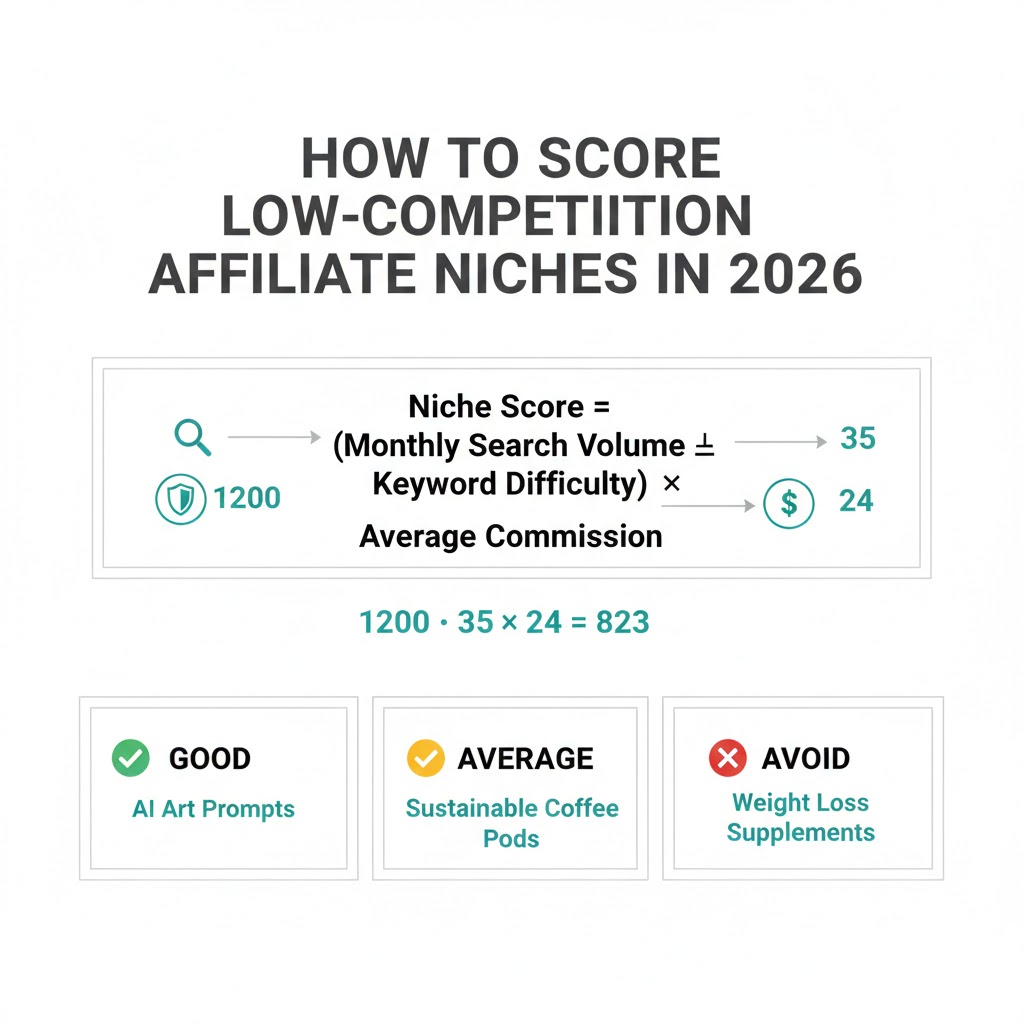
Niche Score = (Search Volume / Keyword Difficulty) * Average Commission Rate
—where Search Volume is monthly queries, Keyword Difficulty is a 0-100 score (lower is better), and Commission Rate is the typical payout percentage (e.g., 10% for digital products). Multiply by 100 for a clean number. A score over 50 signals strong potential. It’s not magic; it quantifies balance between ease of entry and profitability. For instance, if a niche has 1,000 searches, difficulty of 30, and 15% commissions, the score is (1000 / 30) * 15 = 500—prime territory.
This approach mirrors how pros use AI for efficiency, as detailed in my affiliate marketing AI tips for beginners. Test different inputs to see variations; tweaking one variable, like focusing on voice-search optimized keywords, can uncover even lower-competition gems. It’s designed for real people starting out, not tech wizards.
Top Affiliate Niches with Low Competition in 2026
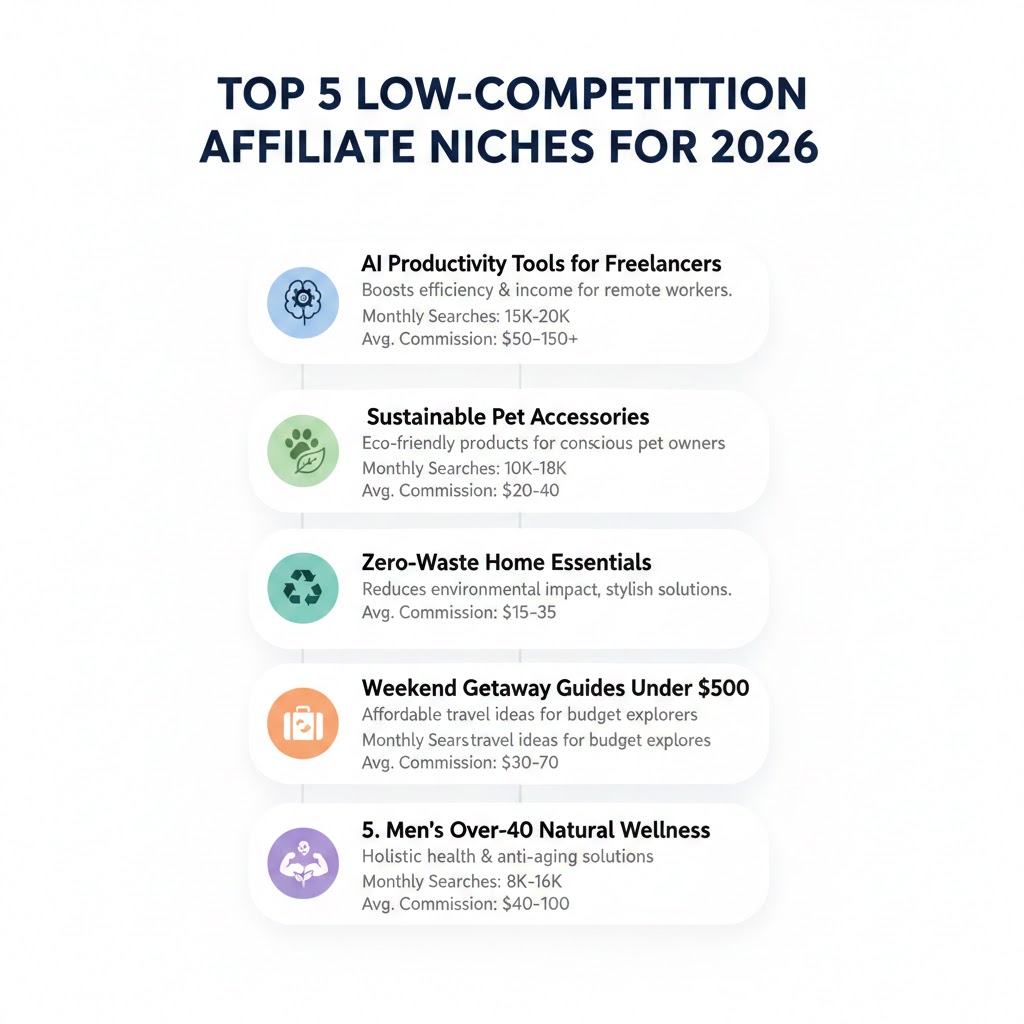
Based on current data, here are standout niches blending growth, low rivalry, and solid earnings. I’ve prioritized sub-niches to keep things actionable, drawing from trends like AI integration and sustainability.
AI and Automation Tools
This niche explodes as businesses adopt AI for everyday tasks, yet sub-areas like “AI for small business productivity” remain under-the-radar. With global AI spending hitting $110 billion, affiliates can promote tools via reviews or tutorials. Commissions average $100+ per sale through programs like Semrush or Jasper AI. Low competition stems from its emerging status—fewer than 10,000 channels cover it deeply. Ideal for tech-savvy creators; pair with voice search strategies from my voice search affiliate guide to rank fast.
Sustainable Living and Eco-Friendly Products
Sustainability isn’t new, but micro-niches like “zero-waste home essentials for urban apartments” face minimal competition while tapping into a $12 trillion green economy. Promote affiliate programs from brands like Patagonia or Thrive Market, earning 5-20% commissions. Demand surges with 78% of consumers prioritizing eco-products, yet content gaps exist in practical, budget-friendly advice. It’s perfect for lifestyle bloggers; low entry since you can start with personal stories.
Pet Wellness Sub-Niches
Broad pet care is competitive, but drill down to “holistic remedies for senior dogs” or “eco-pet toys,” and rivalry drops. The pet industry hits $261 billion globally, with affiliates earning $60 per customer via programs like Ollie. Emotional connections drive conversions—people spend big on pets. Competition is low in specialized angles, making it beginner-friendly with evergreen appeal.
Local Travel and Weekend Getaways
Instead of global travel, focus on “budget weekend trips from major cities under $500.” This sees 1.96 billion domestic trips annually, with less saturation than international guides. Commissions from booking sites like Booking.com average 4-8%. Low competition in regional content lets you dominate local searches; great for storytellers sharing real experiences.
Micro Health Topics
Avoid broad health; target “natural solutions for men’s over-40 weight loss” or “diabetes-friendly gadgets.” These have recurring commissions from SaaS tools, with the health market at $4.5 trillion. Low rivalry in micro-areas, plus high trust from targeted advice. Use AI for content, as in my 2026 AI affiliate tips.
Practical Examples: Evaluating Niches Step by Step
Let’s apply the tool with real scenarios. I’ll walk through calculations using public data for transparency.
Example 1: AI Productivity Tools for Freelancers
Step 1: Identify keywords like “best AI tools for freelancers 2026” via Google Keyword Planner—search volume: 800/month.
Step 2: Check difficulty on Ahrefs: 25 (low).
Step 3: Average commission: 20% on $50 products ($10/sale).
Step 4: Calculate Niche Score = (800 / 25) * 10 = 320. High score means viable.
Why relevant: Freelancers seek efficiency; low comp lets you build a site quickly, as per my beginner’s affiliate guide. Test with your own prompts for personalization.
Example 2: Eco-Friendly Pet Accessories
Step 1: Keyword “sustainable pet toys reviews”—volume: 600/month.
Step 2: Difficulty: 20.
Step 3: Commission: $15 average from Amazon Associates.
Step 4: Score = (600 / 20) * 15 = 450.
Relevance: Pet owners want green options; this sub-niche avoids broad pet wars, suiting eco-conscious affiliates. Real stat: 67% of pet owners prefer sustainable brands. Experiment with variations like “biodegradable cat litter.”
Example 3: Weekend Getaways for Families
Step 1: “Family weekend trips under $300″—volume: 1,200/month.
Step 2: Difficulty: 35.
Step 3: Commission: 6% on $400 bookings ($24/sale).
Step 4: Score = (1200 / 35) * 24 ≈ 823.
Why it fits: Families plan locally post-pandemic; low comp in specifics helps new sites rank. Tie in with digital marketing tips from my affiliate category.
These examples show how tweaking inputs reveals opportunities—try your own to boost engagement.
Frequently Asked Questions
What makes a niche low competition in 2026? It boils down to keyword difficulty under 45 and fewer established players. Tools like SEMrush help spot these; focus on sub-niches for quicker wins, as broad areas get crowded fast.
Can beginners really succeed in these niches? Absolutely, if you start small and build trust. Use free resources like Google Trends, and remember consistency trumps perfection. Many earn $1,000/month within six months by niching down.
How do I monetize without a website? Leverage social media or email lists with affiliate links. Platforms like TikTok work well for short reviews; check my guide on affiliate marketing without a website for tips.
Conclusion
We’ve covered why low-competition niches are your best bet, how to spot them with a simple scoring tool, top picks like AI tools and sustainable pet products, and hands-on examples to get you started. The key? Balance demand with ease of entry, using real data to guide decisions. As the affiliate world evolves, these strategies keep you ahead without the grind.
Ready to dive in? Head to my affiliate beginner’s launchpad and test a niche today—small steps lead to big commissions. Your side income awaits; make 2026 the year you claim it.